? Evergreen conifer
? Decorative
☠️ Poisonous plant
? Long-lived tree or shrub
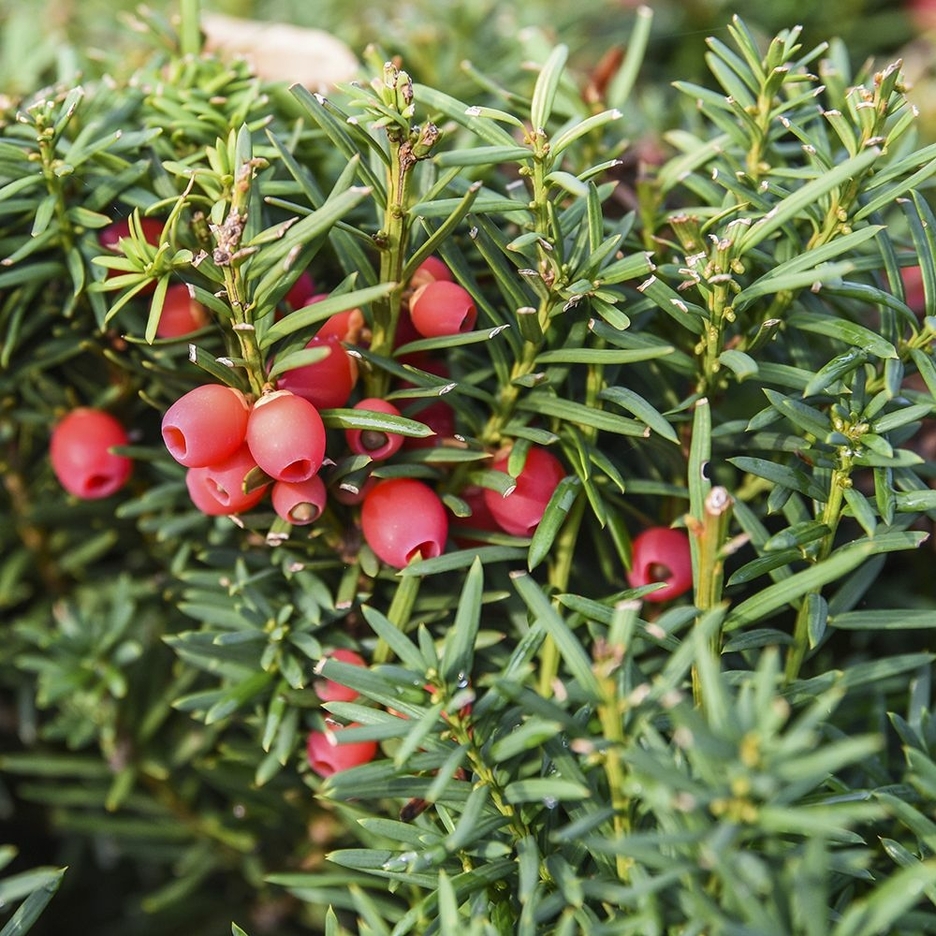
The European yew is one of the oldest conifers in Europe, valued for its dense dark green crown and exceptional longevity. It is naturally distributed in Western, Central and Southern Europe, usually growing in mixed forests, shady places or on hillsides. Yews have been known in Europe since ancient times - even in the Middle Ages they were planted in monastery gardens, castle courtyards and manor parks.
In monastic settings, yews were often associated with longevity, peace, and eternity. Their slow growth and evergreen branches made them suitable for enclosed courtyards, cemetery settings, or for landscaping paths. Their dark green color remained throughout the year, so yews brought life to gardens even in winter.
In manor parks, European yews were highly valued as ornamental plants. They tolerate pruning well, so they were often shaped into hedges, geometric shapes, or ornamental plantings. In the 18th–19th centuries, yews became one of the most important representative park plants in manor gardening. Their dense crown and slow growth allowed for the creation of neat, long-lasting compositions.
In rural homesteads, yews grew less frequently than in manors, as they were considered more ornamental and slow-growing plants. However, in some places they were planted near houses, in cemeteries or churchyards. In old homesteads, yews often survived for decades and became a kind of local landmark.
In urban environments, yews were most often found in parks, near churches or public buildings. Due to their shade tolerance, they were suitable for places between trees or narrower green spaces. Pruned yews were often used in representative flower beds and alleys.
In Eastern Aukštaitija, the European yew was not very common, but in some places it grew near old manors, in cemeteries, or around larger homesteads. Such trees were often passed down from generation to generation as part of the old homestead.
It is important to know that almost all parts of the yew are poisonous. The seeds and needles are especially dangerous. Nevertheless, due to its decorativeness and longevity, the yew is still considered one of the most solemn plants in traditional European gardens.
Today, the European yew is widely used in parks, hedges and in the restoration of historic gardens. Its dark green needles and longevity still recall the traditions of old monastery and manor gardens.