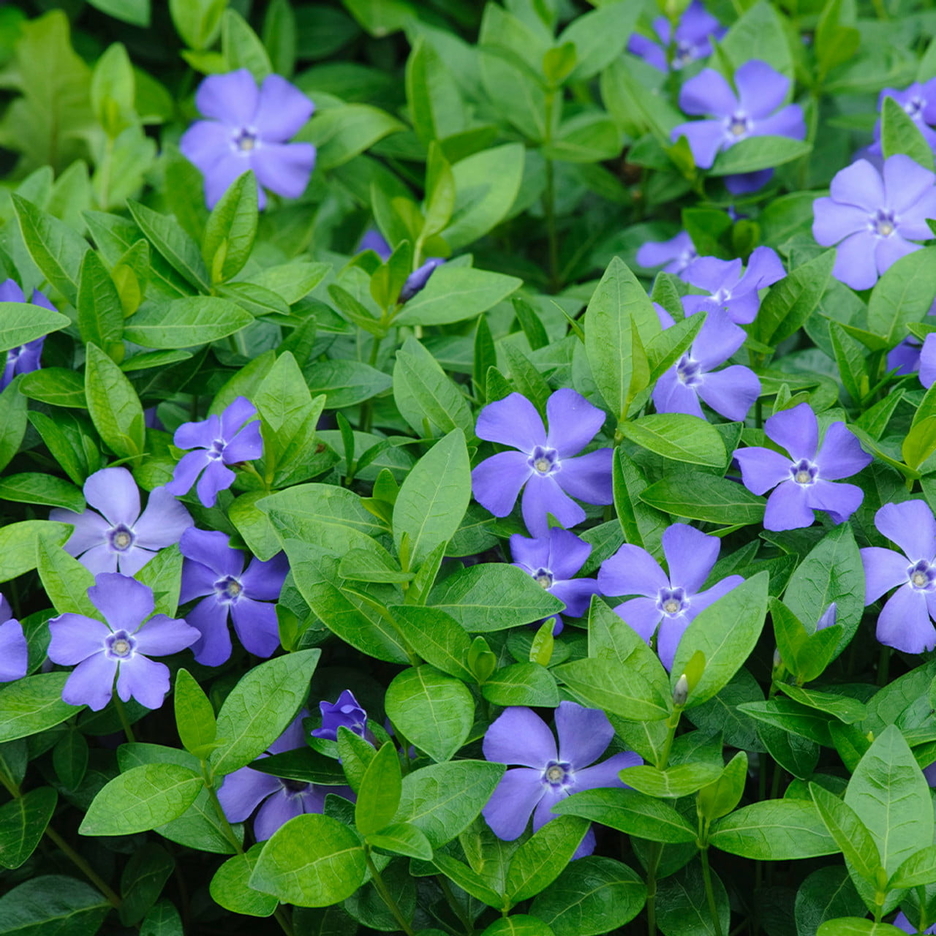
The lesser wintergreen is an evergreen plant that has long been cultivated in Europe, valued for its dense green foliage and bluish flowers that appear in early spring. This species is naturally widespread in Central and Southern Europe, usually growing on forest edges and in shady places. Already in the Middle Ages, wintergreens were grown in monastery gardens as ornamental and medicinal plants, and from there they later spread to manor parks, town green spaces and country estates.
In monastery gardens, the little wintergreen was valued for its ability to quickly form a dense evergreen carpet. It was perfect for shady places - under trees, along walls or along paths. Evergreen leaves were associated with the continuity of life and eternity in the Christian tradition, so wintergreens were often planted in cemeteries or near shrines.
In manor parks, wintergreen was mainly used as a ground cover plant. It grew under trees, along paths, or in other shady places where other plants grew less well. Its early bluish flowers brought life to the parks even before the main spring blooms began.
In rural homesteads, the small wintergreen usually grew on the edges of the garden, near fences or in shady places near the house. Due to its unpretentiousness and evergreen leaves, it was considered a reliable plant that decorated the environment almost all year round. Sometimes wintergreen was also grown in cemeteries or near old homesteads.
In towns, wintergreen was also popular for its ability to quickly cover the ground and form continuous green areas. It was planted near churches, in cemeteries, or in shady flower beds, where it served not only a decorative but also a practical function.
In Eastern Aukštaitija, wintergreen was a fairly common plant in homestead environments. It often grew under fruit trees, near houses, or on the edges of nurseries. Even after homesteads had decayed, dense wintergreen carpets sometimes remained for a long time as a sign of the former place of residence.
Today, the little wintergreen is still valued as a traditional ornamental plant, but in some places it is also considered an invasive species. The rapidly spreading stems can form dense thickets and shade out other herbaceous plants, especially on forest edges or in abandoned areas. Therefore, it is important to plant this plant thoughtfully, especially near natural habitats.
Nevertheless, the little wintergreen remains one of the most recognizable plants of old homesteads. Its evergreen leaves and early spring flowers still evoke the old nursery traditions and peaceful landscapes of historic homesteads.