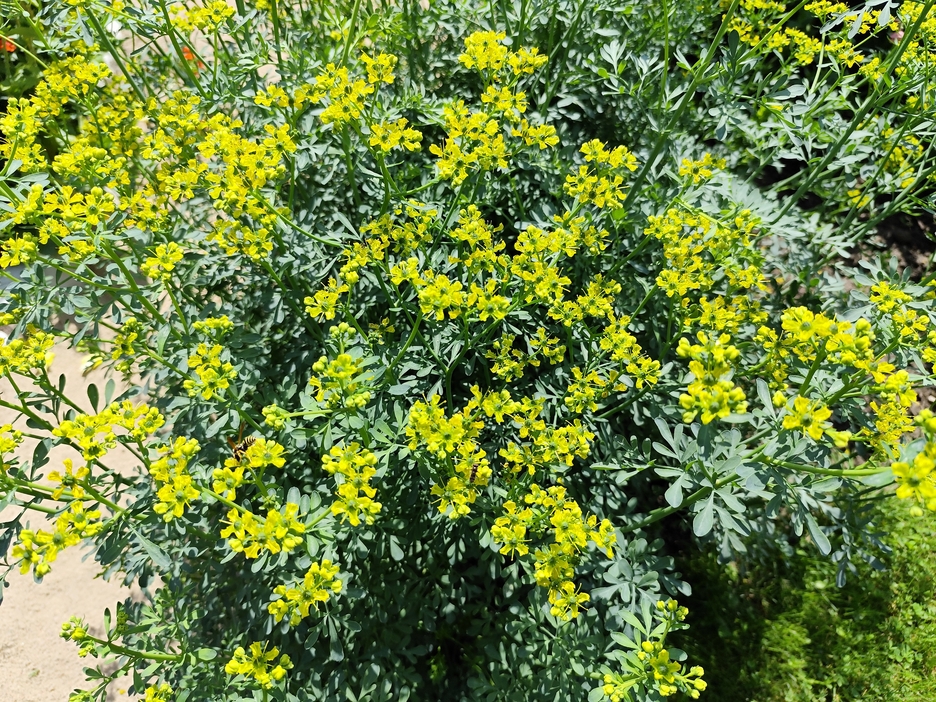
Green rue has long been considered one of the most important and symbolic plants in the Lithuanian flower garden. Although today it is primarily associated with folk customs and wedding traditions for many, rue actually came to our country as a medicinal and spice plant. Its homeland is the Mediterranean region, where it grew in the gardens of ancient Greece and Rome. From there, rue spread throughout Europe, especially in the gardens of monasteries, where it was valued for its strong scent and healing properties.
In the Middle Ages, rue was considered one of the most important medicinal plants. It was used to treat various ailments, and its scent was also believed to protect against diseases and evil spirits. Due to these properties, rue was often planted near the gardens of monasteries and manors. Through such gardens, the plant eventually found its way to peasant homesteads. In Lithuania, rue probably began to be grown as early as the 15th–16th centuries, when Western gardening traditions spread along with Christian culture.
In rural homesteads, rue quickly acquired a special symbolic meaning. It became a symbol of a girl’s chastity, youth, and virtue. For this reason, rues were usually planted in the most visible place in the garden – in central beds or near the windows of the house. In some areas, rues were even given a separate bed. This plant was so closely associated with the lives of girls that a rue garden was often considered an integral part of a girl’s world.
Rutas played a particularly important role in wedding customs. They were used to weave wreaths for the bride and bridesmaids, decorate the bride's clothes, wedding carriages, and even horses. After the wedding, the bride's wreath of rue was burned or otherwise destroyed, thus symbolizing the end of her virginity and the transition to womanhood. These traditions were widespread throughout Lithuania, but were especially pronounced in Aukštaitija.
Rue was also well known in manor gardens. Here it was valued not only for its medicinal properties, but also for its distinctive appearance and aroma. Its bluish-green leaves and strong scent distinguished it from other nursery plants, so it was sometimes planted in ornamental flower beds.
In towns, rue is most often grown near residential buildings, in smaller nurseries, or together with other medicinal plants.
In Eastern Aukštaitija, the tradition of rue was particularly strong. In old homesteads, it often grew alongside other plants with symbolic significance, such as daylilies or lilies. Even in the second half of the 20th century, when traditional nurseries began to disappear, rues were still maintained in many homesteads as an important sign of cultural identity. Today, they are still planted to recreate the environment of old nurseries or to foster Lithuanian traditions.
Although rue is not a very ornate flower, its significance in Lithuanian culture is exceptional. It is one of the few plants that has retained its symbolic meaning to this day and has become a kind of symbol of the traditional Lithuanian flower garden. Today, rue is most often planted in restored old nurseries, ethnographic homesteads or as a symbolic plant reminiscent of Lithuanian traditions.